Saturday, February 16, 2013

Judas the Trógán

Book of Armagh f. 38a.
Trógán is added to the second column half way
down the page in the center margin.
In the Book of Armagh at Matthew 10:4, next to Judas Iscariot's name the Irish scribe wrote trógán in the margin (i.e. miserable wretch). Irish commentators like Cummian regarded Judas as one the chief heretics of the world, along with Simon Magus and Arius, "whose memory is deadly." 

A far more elaborate scribal attack on the enemies of Christ can be seen in a 14th century Greek-Latin diglot manuscript of the Gospels (Greg. & Aland no. 54). In that particular manuscript, possibly written by an Armenian scribe, four different ink colours are used for the gospel content.

For the general narrative he used vermillion, for the words of Jesus he used red, (some bible's still employ this tradition today), for OT quotes of the followers of Jesus (e.g. Mary, John the Baptist, the disciples) he used blue. But for Judas, the Pharisees, the devil and (strangely) for the shepherds in the nativity account, he used black ink.

Sunday, February 3, 2013

The Symbols of the Evangelists in the Irish Tradition

Book of Kells, f. 27v
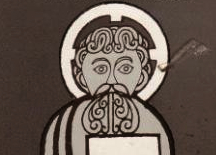
A seventh century Irish commentary on the four Gospels (Expositio quattuor evangeliorum) explains the four symbols of the Evangelists; “There are four symbols which designate the four Evangelists: a man’s face for Matthew; a calf’s face for Luke; a lion’s face for Mark; and an Eagle’s face for John. All these our Lord Jesus Christ fulfilled in Himself. He was a man in his birth, a calf in his sacrifice, a lion in his resurrection, and an eagle in his ascension.”

Another Irish writer applies the symbols to the Christian's life. The Lion represents the strong in faith; the Calf, the merciful; the Man, humility; and the Eagle stands for the mystic.

The ultimate source for these widespread symbols of the four evangelists is in Ezekiel 1.10 and Revelation 4.7. Next time you're in an old church keep your eye out for these four symbols, you're bound to see them somewhere.

(To my Corkonians, have you noticed them above the west front facade of St. Finbarr's Cathedral?)

Tuesday, December 18, 2012

The Magi Tradition in the Early Irish Church


Gentile da Fabriano's Adoration of the Magi (1423)

The Three Wise Men or Magi are an integral part to our conception of the traditional Christmas Nativity scene. The Magi’s cameo appearance in Scripture is confined to Matthew’s Gospel, where they are simply referred to as Magi (μάγοι), not kings and not three. Not surprisingly much of the traditional Christian nativity scene is taken from Patristic exegesis and apocryphal writings. For example, how many Christmas cards have we seen with Mary on a donkey en route to Bethlehem? This story of the donkey is not found in the Bible but is drawn from the apocryphal work known as the Protoevangelium of James (17.2). Also, why do we always see nativity scenes with an ox and a donkey peering into the crib? They are not mentioned in the Gospel accounts; rather this is the direct influence of Patristic exegesis, which applied the ox and donkey of Isaiah 1.3 to the birth of Jesus and the acceptance of Christ by the Gentiles (Greg. of Nazianzus, On the Birth of Christ: Oration 38.17). A reminder that Israel had rejected her Messiah but the Gentiles had believed.

The brief account of the Magi in Matthew’s Gospel was soon supplemented with plenty of legend and lore. The early Irish church was among the earliest parts of the western church to develop the Magi stories. The names of the Magi are given in two eighth century works associated with the Irish tradition (Collectanea et Flores, and Excerptions partum). The Magi are named as; Balthasar, Melchoir and Gaspar. These names were not invented by the Irish but were taken from earlier Greek Magi traditions.

The tradition of the Magi being three in number was derived from the three different gifts listed in Matthew’s Gospel (gold, frankincense and myrrh). The idea that they were kings was derived from Psalm 72.11, "And all kings of the earth shall adore him: all nations shall serve him." (Tertullian, Adversus Marcionem 3.13). In the east, however, there is an ancient tradition that the Magi were 12 in number. Several lists of the 12 Magi survive in Syriac and Armenian manuscripts.

Early Irish works (e.g. Expositio IV Evangeliorum, and In Matthaei Evangelium Expositio) interpreted the three Magi as representing descendants of the three sons of Noah, which encompassed all of humanity. Furthermore, since the three Magi had come to see the Word incarnate, they also represented the means of interpreting the written Word of God, namely the historical, theological and eschatological aspects!

The seventh century Irish writer, Augustinus Hibernicus, suggested various interpretations on the nature of the star that guided the Magi. He rejected the idea that it was a natural star on the basis that God had already fixed the stars in the firmament (Gen 1.7). He argued that the guiding star might have been an angel (cf. Rev 1.20 where stars are symbolically referred to as angels), or more likely the Holy Spirit.

The Story of the Arrival of the Magi in
an Leabhar Breac
fol. 137a.
Perhaps the most interesting development of the Magi tradition in Ireland is an extended account of their arrival in Bethlehem. The manuscript an Leabhar Breac preserves the story in Gaelic. The story begins with St. Joseph standing outside a house in Bethlehem chatting to Simeon. He sees the colorful Magi approach and wonders if they might be Druids because they seem to be arguing over astrology. Joseph is not impressed with the strange visitors and pointedly asks them, “Tell me, for God’s sake, who you are, and from where have you come to my house without my permission?” Unperturbed the Magi inform Joseph that they have come from India and Arabia and “various lands in the eastern world.” They even inform Joseph on the names of their horses; Dromann-Darii, Madian, and Effan (this is borrowed from Isaiah 60.6 dromedarii Madian et Epha (i.e. “camels of Madian and Epha”). They tell Joseph that they have come to worship the king of the world. Reluctantly Joseph lets them enter the house, but sends Simeon after them to keep an eye on things.

Simeon reports back to Joseph that these Druids are fine fellows for they all kissed the child’s feet in reverence and presented him with beautiful gifts, moreover, “they are not like the shepherds who gave him no gifts!

The Magi bless Joseph informing him that he is truly blessed to be the foster father of the Son of God.

O righteous and holy man, you have great good fortune, if you but know it, for the son of the King of heaven and earth is under your fosterage. For we, indeed, have more knowledge of the one who is in your care than you have. The boy who is with you is the God of gods, and Lord of lords, the creator of the elements, the angels and the archangels.”

Joseph’s initial suspicion of these strange men gives way to joy and he invites them to a meal. The Magi decline the invitation, “For we have already been satisfied with the heavenly banquet!” The whole visit is interpreted by the narrator as marking “the beginning of the Gentiles’ belief in Christ, and the gifts they offered were the first offerings of the Gentiles to God, their first-fruits.

Saturday, November 17, 2012

Charlemagne and the Irish

Coronation of Emperor Charlemagne

Emperor Charlemagne is well known for his political and cultural achievements in what is termed the Carolingian Renaissance. The court of Charlemagne was a meeting point of three cultural and scholarly traditions, the Irish, Italian and English. Many Irish scholars contributed to this European cultural revival. Among these wandering Irish scholars was the famous Clement of Ireland (c. 750 – 818) who was a teacher under the patronage of Charlemagne. His arrival to the continent was mentioned in the medieval ‘Life of Charlemagne’ by Notker Balbulus (c. 884).
“Now it happened, when Charlemagne had begun to reign alone in the western parts of the world, and the pursuit of learning had been almost forgotten throughout all his realm, and the worship of the true God was faint and weak, that two Irishmen came from Ireland to the coast of Gaul along with certain traders of Britain. These Irishmen were unrivalled for their skill in sacred and secular learning: and day by day, when the market crowds gathered round them for trade, they exhibited no goods for sale, but cried out and said, "Everyone that desires wisdom, let him draw near and take it at our hands; for it is wisdom that we have for sale."
Now they declared that they had wisdom for sale because they said that the people cared not for what was given freely but only for what was sold, hoping that this might incite them to purchase wisdom along with other goods; and also perhaps hoping that by this announcement they themselves might become a wonder and a marvel to everyone: which indeed turned out to be the case. They continued shouting their proclamation and in the end those who wondered at them, or perhaps thought them insane, brought the matter to the ears of King Charlemagne, who always loved and sought after wisdom. Charlemagne ordered them to come with all speed into his presence and asked them if it were true, as fame reported of them, that they had brought wisdom with them. They answered, "We both possess it and are ready to give it, in the name of God, to those who seek it worthily." Again he asked them what price they asked for it; and they answered, "We ask no price, O king; but we ask only for a fit place for teaching and quick minds to teach; and besides food to eat and clothing, for without these we cannot accomplish our pilgrimage." This answer filled the king with a great joy… he made one of them named Clement reside in Gaul, and to him he sent many boys both of noble, middle and humble birth…and he set aside for them buildings suitable for study. But he sent the second Irish scholar into Italy and gave him the monastery of Saint Augustine near Pavia, that all who wished might gather there to learn from him.”

Monday, October 15, 2012

Adam's Rib: an early Irish interpretation


Christ the Second Adam.
Book of Kells.

Sacramentum hoc magnum est! This mystery is profound. So an early eighth century Irish exegete noted as he wrote his commentary on the book of Genesis [Codex Palatino-Vaticanus 840]. The mystery in question was the creation of Eve from the rib of Adam. In setting forth his interpretation of Genesis 2.21-22 our anonymous Irish commentator offered several layers of interpretation, historical, anagogical, and spiritual.

His historical interpretation was as follows,
“[God took one] of the ribs. Why was the woman formed from a rib? For if she were formed from his foot or hand or some other part she would stand in shame before him. Further it shows the greatest love, for the rib is, after all, closest to the heart, as it is said, the rib is the guardian of the heart.”

The point here is two fold, firstly as O’Loughlin notes, according to the Irish interpretation in using the rib God was intentionally choosing it to convey the standing men and women were to have in the others eyes. Eve was taken from Adam’s side so she could be helper and partner, not slave or master. A similar interpretation of Adam’s rib is found in the Irish ‘Book of Adam’,
“From the eighth upper rib of the chest on Adam’s right side Eve was formed to be his equal.”
Secondly the point made in the Irish Genesis commentary is that the rib was closest to the heart and thus points to the intimacy and love shared between Adam and Eve. As an Irish poem in the Book of Uí Maine so nicely puts it, ‘when Adam saw the beauty of Eve, he smiled for the first time!’ (So did I when I first saw Katie!).

From this the spiritual and allegorical interpretation is offered. The spiritual interpretation sees the opening of Adam’s side as parallel to the opening of Christ’s side on the cross. Thus Eve is a type of the Church which is born out of the sacrifice of Christ, the second Adam. Lastly, the allegorical interpretation again parallels the imagery of Adam-Christ and Eve-Church. Just as Adam recognized Eve as bone of his bone and flesh of his flesh so this is a foreshadowing of Christ recognizing the church his bride as flesh of his flesh. The ultimate source for this parallel is St. Paul, and the Irish commentary cites Ephesians 5 as its supporting text,

“In the same way husbands should love their wives as their own bodies. He who loves his wife loves himself. For no one ever hated his own flesh, but nourishes and cherishes it, just as Christ does the church, because we are members of his body… The two shall become one flesh. This mystery is profound and I am saying that it refers to Christ and the church. However, let each one of you love his wife as himself, and let the wife see that she respects her husband.” Ephesians 5:28-30, 32–33.

Thus for the Irish, the creation of Eve from the rib of Adam was instructive to the relationship of the Church to Christ, as his beloved, even members of his body, In Carne Una. The mystery is profound indeed. Furthermore, it was seen as having anthropological significance. Eve was taken from Adam’s side, an act that speaks of ontological equality between men and women. This last point would be taken up by Aquinas in his Summa (1a, 92, 3c). The source for this interpretation of Adam's rib ultimately traces back to the early Irish church.

Sunday, September 9, 2012

Columbanus on desiring God


"Most loving Saviour, reveal yourself to us, that knowing you we may desire you, that desiring you we may love you, that loving you we may ever hold you in our thoughts."


s. Columbanus c. AD 600