Thursday, March 29, 2012

1 John 5:7 and Irish Exegesis

Several Early Church Fathers commented on various verses from the Catholic Epistles but none ventured to write a verse by verse commentary on them. That was until the seventh century when a remarkable Biblical commentary was written in Ireland.

This Latin commentary on the Catholic Epistles was composed by an anonymous Irish scholar (c. AD 680) and is now preserved in a single ninth century codex in Karlsruhe Germany (Karlsruhe, Badische Landesbibliothek Cod. Aug. 233). This single remaining codex, of a once popular commentary, can tell us several important things about the early Irish church.


Prior to the discovery of codex 233 the earliest Latin commentary on the Catholic Epsitles was thought to be Bede’s Expositio in epistolas catholicas which was written in the eighth century. However, the Irish commentary predates Bede's work and as McNally has shown Bede availed of the earlier Irish work. This shows us the benefit that the English church drew from availing of Irish exegetical sources. Bede had great praise for Irish scholarship. Furthermore, the ninth century Karlsruhe manuscript was not copied by an Irish scribe (the paleographical evidence points to a German scribe), this shows us that European Christians were copying and studying theological works produced by the Irish.

Our anonymous Irish theologian (Scotti Anonymi) cites from several well-known early church fathers in his commentary (e.g. Jerome, Augustine etc.) as well as several Irish theologians not known outside of Ireland (Manchianus, Bercannus, Bannbannus, Lodcen, and Brecannus). This shows our writer as remarkably confident in his own native theological tradition, citing homegrown talent along side the traditional Latin heavy weights.

Most of the Irish theologians that he cites come from the southern part of Ireland, particularly the areas of the Dési, viz. Lismore. He cites Manchianus as doctor noster (our teacher), which has led McNally to postulate that our writer may have been the brilliant Irish theologian known as the Augustinus Hibernicus, or the Irish Augustine. Augustinus' most famous work, De mirabilibus sacrae scripturae (On the miraculous things in sacred scripture), was widely read in Europe and was so good that it was assumed to be the work of Augustine of Hippo (it was printed by Migne in the 19th century as part of Augustine of Hippo’s works). The Irish Augustine in his work on miracles refers in passing to Manchianus as his pater. If this commentary on the Catholic Epistles really is the work of the Irish Augustine remains to be seen, what we can at least say, is that both the commentary and De mirabilibus emerged from the same scholarly circles, viz. the south of Ireland in the seventh century.
Looking at the commentary itself we can say that the Biblical text cited is typically Irish; predominantly Vulgate with numerous Vetus Latina interpolations. I was most interested to see if the comma Johanneum was present in his text, it wasn’t. It doesn’t appear in the Book of Armagh either. His commentary for 1 John 5.6-8 is an excellent example of early Irish exegesis and is worth taking a look at.

The water and blood of verse 6 are interpreted as referring to the passion of Christ, John 19:34 is cited as support. The three that testify in verse 7 are identified in verse 8 as Aqua, Sanguis [et] Spiritus, i.e. water, blood and Spirit. This clearly shows us that he was using an ESV rather than a KJV! He then offers two interpretations for these three witnesses, a moral interpretation and an anagogical interpretation. This multi layered hermeneutic was very common in Irish exegesis as it was in the western church as a whole.

The moral interpretation interpreted the three witnesses as baptism (water) martyrdom (blood) and the Spirit filled life (Spirit). Christ’s incarnation is presented as the prime example for this moral interpretation. The anagogical interpretation is Trinitarian. Water is said to speak of the Father (ingeniously Jeremiah 2:13 is cited as support). Blood speaks of Christ, especially His passion on the cross, and the Spirit is the Holy Spirit.

How do these Three bear witnesses and to what do they bear witness? Our anonymous Irishman explains that the Father bears witness to the Son when He speaks at Christ’s baptism (Matt 3:17 is cited). Christ bore witness of Himself with the Father (John 8:18 is cited) and the Holy Spirit also bore witness of Christ (John 15:26 is cited). So we can see that according to our commentator the witness of the Trinity is to Christ. Finally he interprets the closing clause of verse 8, et tres unum sunt as referring to the oneness of nature and power of the Trinity.

A fascinating glimpse into early Irish exegesis!

Friday, January 13, 2012

The Forerunner

"It is fitting for us to fulfill all righteousness (Matt 3:15). Notice how Jesus included John the Forerunner here in His call to fulfill all righteousness. This is the same John that leaped in his mother’s womb at the voice of the Theotokos. The same whose hands were not worthy to carry the shoes of our Lord let alone lay hold of the Christ and plunge him into the waters of baptism. The same who later doubted Jesus by asking, are you the Christ or should we wait for another? The obvious conclusion here is that though this same John was the greatest of all the Prophets, yet he was still a sinner, unable to fulfill all righteousness. Yea indeed, not only John but all men have failed to fulfill all righteousness. All that is, except one, the Only Begotten Son. And here is our lesson, it is only by participation in His life, in His death, in His burial, and in His resurrection that we too, like John the Forerunner, can see heaven opened and all righteousness fulfilled. As Hilary has written; 'For by Him must all righteousness have been fulfilled, by whom alone the Law could be fulfilled.' Though we doubt and fail, still it is fitting for us to fulfill all righteousness, if we are found in Him. It is fitting for us to fulfill all righteousness if we have been sealed with the Holy Spirit. It is fitting for us, for He and not ourselves has made us fit to do it with Him. By such could John bear witness of Him in life as well as death."

Monday, November 21, 2011

The Carmen Navale - The Boat Song

Columbanus was early Ireland’s greatest missionary. Together with a motley crew of pilgrims for Christ he traversed across modern day France, Germany, Switzerland and ended up in northern Italy where he spent the remaining years of his life correcting the heresies of the Arians of northern Italy with the cauterizing knife of the Scriptures. For Columbanus, life was a journey, a pilgrimage, a voyage of discovery and sometimes of hardship. Its final destination was union with Christ.

French historian Georges Goyau noted, the Celtic missionary genius had produced individuals of outstanding energy, it had given the world magnificent apostolic personalities. Of these Columbanus was probably the greatest. According to Léon Cathlin, Columbanus was together with Charlemagne the greatest figure of France in the early Middle Ages. Henri Petiot described him as a sort of prophet of Israel, brought back to live in the sixth century, as blunt in his speech as Isaiah or Jeremiah. And not to be outdone, Robert Schuman (former French Prime Minister and main architect of what would become the EU) lauded Columbanus as the patron saint of those who seek to construct a united Europe!

Journeying up the Rhine in 610, Columbanus and his disciples supposedly chanted his famous ‘boat song’. One can almost hear the Irish monks dig their oars into the Rhine’s formidable current as they struggle upstream. The poem compares the surging storm waters with the trials and struggles of the Christian life. Columbanus sees the tempests and storms of life overcome by the one who is in Christ. He frequently used the analogy of storms at sea as a picture for hardship and trials. The Carmen Navale is one of my favorite poems attributed to Columbanus. The translation is taken from Tomás Ó Fiaich's work 'Columbanus in his own words'.

Lo, little bark on twin-horned Rhine, From forest hewn to skim the brine, Heave, lads, and the echoes ring!

The tempests howl, the storms dismay, But manly strength can win the day, Heave, lads, and let the echoes ring!

For clouds and squalls will soon pass on, And victory lie with work well done, Heave, lads, and let the echoes ring!

Hold fast! Survive! And all is well, God sent you worse, he’ll calm this swell, Heave, lads, and let the echoes ring!

So Satan acts to tire the brain, And by temptation souls are slain, Think, lads, of Christ and echo Him!

Stand firm in mind ‘gainst Satan’s guile, Protect yourselves with virtues foil, Think, lads, of Christ and echo Him!

Strong faith and zeal will victory gain, The old foe breaks his lance in vain, Think, lads, of Christ and echo Him!

The King of virtues vowed a prize, For him who wins, for him who tries, Think, lads, of Christ and echo Him!

Tuesday, November 15, 2011

Mise agus Pangur Bán! I and white Pangur!


Learning Biblical Greek is like a cat hunting a mouse, plenty of concentration, some frustration, and then the delight of finally ‘getting it’; at least that’s how one medieval Irish monk described it! 

Greek paradigms in MS Stift St. Paul Cod. 86b/1
A fragmentary manuscript dating from around the year 800 preserves an Irish student’s study notes for his upcoming Greek exam. Filled with Greek paradigms and vocabulary it resonates with any student of the Biblical languages. The manuscript is famous for a humorous poem in Irish that compares the student’s study of Greek with his pet cat’s pursuit of mice. Pangur Bán, as his cat was called, was a diligent student of hunting mice. He was persistent, practiced every day and most importantly, he enjoyed it! I think those are good habits for any student. Stokes printed the original Irish text in volume II of Thesarus Paleohibernicus, Robin Flower’s translation is perhaps the most famous.
              
I and Pangur Bán, my cat
'Tis a like task we are at;
Hunting mice is his delight
Hunting words I sit all night.

Better far than praise of men
'Tis to sit with book and pen;
Pangur bears me no ill will,
He too plies his simple skill.

'Tis a merry thing to see
At our tasks how glad are we,
When at home we sit and find
Entertainment to our mind.

Oftentimes a mouse will stray
In the hero Pangur's way:
Oftentimes my keen thought set
Takes a meaning in its net.

'Gainst the wall he sets his eye
Full and fierce and sharp and sly;
'Gainst the wall of knowledge I
All my little wisdom try.

When a mouse darts from its den,
O how glad is Pangur then!
O what gladness do I prove
When I solve the problems I love!

So in peace our tasks we ply,
Pangur Bán, my cat, and I;
In our arts we find our bliss,
I have mine and he has his.

Practice every day has made
Pangur perfect in his trade;
I get wisdom day and night
Turning darkness into light.

Pangur Bán poem: MS Stift St. Paul Cod. 86b/1

Friday, June 10, 2011

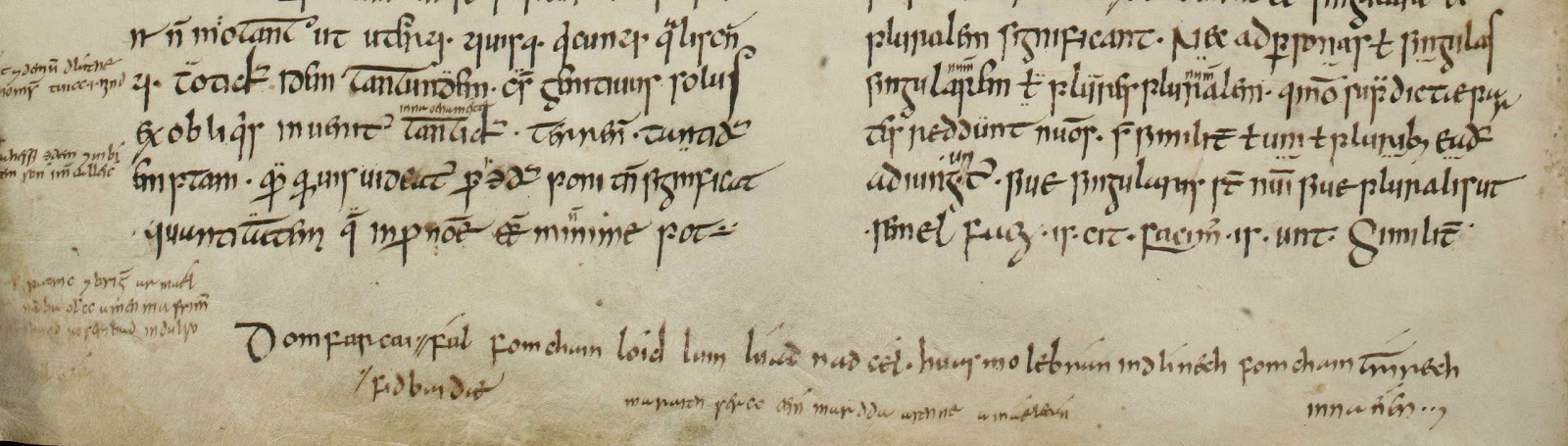
The scribe in the woods

Codex Sangallensis no: 904, f.203

An Irish poem Dom-Farcai fidbaide fál, ("A hedge of trees overlooks me") was added by an Irish scribe in the margins of the Latin grammar manuscript he was writing sometime in the early ninth century. Copying a Latin grammar book was tedious but important work. Manuscripts like these allowed Irish Christians to learn and improve their Latin, which opened up for them the Scriptures and Patristic studies. The Irish church was unique in Western Europe as she had to learn Latin as a foreign language without ever having been part of the Roman Empire. It was a daunting struggle, but tackled with remarkable tenacity and excitement by Irish scholars, who saw the value of Biblical literacy. The little poem Dom-Farcai fidbaide fál records how the Irish scribe could enjoy God’s presence through the beauty of nature, even while working hard copying out a Latin grammatical work.

A hedge of trees overlooks me
A blackbird's lay sings to me
It is an announcement I won't conceal!
Above my lined book the bird's chanting sings to me.

A clear voiced cuckoo sings to me (godly speech!)
In a grey cloak from bramble fortresses
The Lord is indeed good to me
Well do I write beneath a forest of woodland