Friday, April 15, 2011

Surrendering wholly to grace

St. Bernard of Clairvaux was one of the most influential theological forces of the medieval period, his influence on monasticism led to the Cistercian order. The famous abbey at Clairvaux, where Bernard was Abbot, produced several distinguished leaders of the western church, including a Pope. Visitors to Clairvaux were frequent, including a man who came from ‘the uttermost parts of the earth’, namely the Irish bishop Malachy who struck up an abiding friendship with Bernard.

Among Bernard’s many works of Biblical commentary are several sermons on the Song of Songs. In the following excerpt Bernard contemplates the nature of God’s grace in the heart of the believer.

A little later the Bride uses the same words again, unless I am mistaken, but not in the same order. With exquisite subtlety, she follows the order of the Prophet and says: `I am my Beloved's and he is mine.' Why this? Surely that she may show herself more full of grace when she surrenders wholly to grace, attributing to him both the beginning and the ending. How indeed could she be full of grace if there were any part of her which did not itself spring from grace? There is no way for grace to enter, if merit has taken residence in the soul. A full acknowledgment of grace then is a sign of the fullness of grace. Indeed if the soul possesses anything of its own, to that extent grace must give place to it; whatever you impute to merit you steal from grace. I want nothing to do with the sort of merit which excludes grace. I shrink from whatever I possess, that I may truly possess myself, unless that which makes me my own is to some extent my own. Grace restores me to myself, freely justified, and thus sets me free from the bondage of sin. For where the Spirit is, there is liberty.

s. Bernard, sermon on Song of Songs no. 67, part vi.

Monday, April 11, 2011

Early Irish Commentary on Mark's Gospel

Qui omnes condemnaverunt eum esse reum mortis
"And they all condemned him as deserving death" Mk 14.64
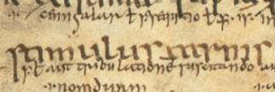
A manuscript in Turin preserves an early commentary on Mark’s Gospel written by an Irish theologian  (s. Cummean c.610). In Mark 14:64 where Jesus is condemned to death by the Sanhedrin the commentary reads.
So that with his cross He might cancel our own crucifixion, and by his death He might destroy our death. With the form of a serpent He slays the serpent, because by the serpent made of wood the other serpents are swallowed up. Whence He said through the prophet: ‘I will be your death, O death, and your destruction, O Hell’ (Hosea 13.14 Vul.). His reproach has removed our disgrace. His bonds have set us free. By the crown of thorns on His head we have gained the diadem of the kingdom. With His wounds we are healed. By his burial we are resurrected. By His descent into Hell we rise to heaven. Foreseeing all this, the prophet said, “What shall I render unto the Lord for all his benefits toward me?” (Psalm 116.12).

Wednesday, April 6, 2011

The Suspended Nun

In the book of Judges chapter eighteen verse thirty an idolatrous Levite who participated in idol worship is named as Jonathan the son of Gershom, son of Moses. The NJKV and NASB read ‘son of Manasseh’ here instead of ‘son of Moses’ (ESV, NIV). Which is it? This is the interesting case of ‘the suspended nun’. The nun in question is not a woman who is part of a religious order but the fourteenth letter of the Hebrew alphabet.

The base text used in the OT for the NKJV, NASB, ESV and NIV is the same, namely the Masoretic Text as preserved in Codex Leningradensis B19a. So why do some versions read Manasseh and some Moses? The reason is that the name Manasseh is written in Hebrew as (מְנַשֶּׁה) and Moses is written as (מֹשֶׁה), the only difference in the consonantal text being the letter nun. In the Leningrad manuscript the name in question is written as Moses (מֹשֶׁה) but with the letter nun suspended between the mem and the shin letters. Several Masoretic manuscripts have this peculiar orthography as can be seen in this picture from the Aleppo Codex (which is even older than the Leningrad manuscript). Thus Moses can be re-read as Manasseh using the suspended nun.

If one looks to the Septuagint (LXX) we also get a diversity of scribal opinion. For example Codex Alexandrinus reads Moses (Μωυσῆς) and Codex Vaticanus reads Manasseh (Μανασση), so clearly both variant readings were in existence prior to the later medieval Masoretic Text. Incidentally, the Vulgate reads Moses (Mosi) here.

The reason for the suspension of the nun is explained in the Talmud, (Baba Bathra f. 109b) observes: “Was he a son of Gershom, or was he not rather a son of Moses? As it is written, the sons of Moses were Gershom and Eliezer, but because he did the deeds of Manasseh, the Scripture assigns him to the family of Manasseh.”

The shame that a grandson of Moses could be an apostate was hard to read and so the scribes added the consonant nun to theologically show that Jonathan was spiritually the son of the chief apostate in the OT, the wicked Manasseh. Such euphemistic interaction with the text was characteristic of Jewish scribes. The suspension of the nun allows the text to be read without bringing reproach on Moses, yet at the same time preserving the name Moses in the text. That it originally read Moses is clear, as is the high regard the Jewish scribes held Moses.

Thursday, March 17, 2011

Patrick's Rage

Here follows a brief excerpt from st. Patrick’s lesser known work, his Epistola Militibus Cororici. It was written in response to the enslavement of some of Patrick's flock by men under the control of a minor British king, Coroticus. So Patrick, the former slave, rails against the injustice of slavery; it is passionate, moving and well worth a read. Despite what we sometimes read of st. Patrick and the 'Celtic Church', here in his own words he calls the Irish 'barbarians' and 'apostates' and the Romans 'holy'!

I am Patrick, yes a sinner and indeed untaught; yet I am established here in Ireland where I profess myself bishop. I am certain in my heart that "all that I am," I have received from God. So I live among barbarous tribes, a stranger and exile for the love of God. He himself testifies that this is so. I never would have wanted these harsh words to spill from my mouth; I am not in the habit of speaking so sharply. Yet now I am driven by the zeal of God, Christ's truth has aroused me. I speak out too for love of my neighbors who are my only sons; for them I gave up my home country, my parents and even pushing my own life to the brink of death. If I have any worth, it is to live my life for God so as to teach these peoples; even though some of them still look down on me.

I myself have composed and written these words with my own hand, so that they can be given and handed over, then sent swiftly to the soldiers of Coroticus. I am not addressing my own people, nor my fellow citizens of the holy Romans, but those who are now become citizens of demons by reason of their evil works. They have chosen, by their hostile deeds, to live in death; comrades of the Irish and Picts and of all who behave like apostates, bloody men who have steeped themselves in the blood of innocent Christians. The very same people I have begotten for God; their number beyond count, I myself confirmed them in Christ.

Thursday, March 10, 2011

Stormy seas, a scribe's comfort

The Vikings were a feared and ferocious warrior people. Ireland and Europe in general endured their bloody raids and wars for centuries. In France the Franks handed over a sizeable slice of their kingdom to these mighty “men from the north”, which they named Normandy. The Irish were less generous. Irish scribes wrote scathingly of these gentiles from the north (which is slightly ironic since they were gentiles themselves!). We are told of the Irish coast filled with “countless sea-vomitings of ships” loaded with Vikings and Pirates. The annals repeatedly record churches burned to the ground, manuscripts and shrines destroyed and the slaughter of Christians by these ‘gentile hoards’.

To the Irish scribe, these Nordmanni represented the forces of darkness. Illiterate, pagan, and savage. No monastery or church was safe. The wealthier monastic settlements like Clonmacnoise, Durrow and Armagh were frequently raided. Even the desolate rock of Sceilig Mhichíl, off the Kerry coast, was raided in 823. The Annals of Inisfallen record that the Vikings didn’t find anything worth taking just an old decrepit hermit called Étgal. They carried him off and left him to starve to death in captivity.

Around the year 800 an anxious Irish scribe was staying up late one night busy copying a Latin grammar book. Viking raids were an ever present threat, but this night in particular our scribe paused his copying and penned a small poem in the upper margin of his manuscript (pictured above). As he listened to the howling wind outside he smiled and began to write “Is acher in gáeth innocht”, ‘the wind is fierce tonight!’ The seas were rough, too rough for the dreaded Viking long-boats. He could rest easy tonight.

The wind is fierce tonight
It ruffles the ocean’s fair mane
I do not fear the wild warriors of Norway
Sailing on a quiet sea!

Monday, March 7, 2011

The Würzburg Glosses


F. 7v
Codex Paulinus Wirziburgensis currently resides in the university library of Würzburg, Germany. It was produced by Irish scribes sometime around the year 800 and contains the Latin text of the Pauline epistles (plus Hebrews). What is noteworthy about this manuscript, however, are the thousands of old Irish glosses in the margins and between the lines. The glosses provide explanations and applications of the text from Patristic sources.

 Interestingly, the main source for the commentary is the heretic Pelagius. He is cited frequently by name which shows the Irish scribes were open about using a writer who came in for some very heavy criticism from the Church Fathers and Jerome in particular (who was highly respected by Irish theologians). Jerome called Pelagius stolidissimus et Scottorum pultibus praegravatus, a stupid man weighed down with Irish porridge!


The 3000 or so Irish glosses are a vital witness to reconstructing old Irish, and also give us some insights into the Biblical interpretation of the early Irish church. An interesting gloss is written over 2 Corinthians 12:7, where Paul mentions his stimulus carnis, or thorn in the flesh. The Irish gloss reads, Cenngalar (headache). This may be an allusion to the Latin theologian Tertullian (d.220) who wrote that Paul’s thorn in the flesh may have been per dolorem, ut aiunt, auriculae uel capitis (a pain in the ear or head). 


f. 17v stimulus carnis / Cenngalar
Like so many Irish manuscripts its survival was due to being taken to the continent by wandering Irish monks, while at home countless manuscripts and libraries were destroyed by the Vikings. Manuscripts like the Codex Paulinus were valuable study tools and welcome reading to the many Irish scholars in Germany and elsewhere. As the writing style in Europe evolved the insular miniscule hand used in this manuscript became archaic and hard to read, so these manuscripts sat unused in European monasteries and libraries. Dusty relics like these speak of the vibrancy of the early Irish church and her many pilgrims for Christ.

For further details see:
Ó Néill, Pádraig P., “The Old-Irish glosses of the prima manus in Würzburg, m.p.th.f.12: text and context reconsidered”, in: Richter, Michael, and Jean-Michel Picard (eds.), Ogma: essays in Celtic studies in honour of Próinséas Ní Chatháin, Dublin: Four Courts, 2002. 230–242.

Breen, Aidan, “The Biblical text and sources of the Würzburg Pauline glosses (Romans 1–6)”, in: Ní Chatháin, Próinséas, and Michael Richter (eds.), Irland und Europa im früheren Mittelalter: Bildung und Literatur / Ireland and Europe in the early Middle Ages: learning and literature, Stuttgart: Klett-Cotta, 1996. 9–16.

Ní Chatháin, Próinséas, “Notes on the Würzburg glosses”, in: Ní Chatháin, Próinséas, and Michael Richter (eds.), Irland und die Christenheit: Bibelstudien und Mission. Ireland and Christendom: the Bible and the missions, Veröffentlichungen des Europa Zentrums Tübingen. Kulturwissenschaftliche Reihe, Stuttgart: Klett-Cotta, 1987. 190–199.

Friday, February 18, 2011

In Te Christe - A hymn from the Irish Church

Congregational singing was an important part in the spiritual life of the early Irish Church, as it was in Christendom as a whole. The Psalter was the hymn book par excellence. The Psalter was the most studied book in the monastery and most would have memorized it, sometimes singing all 150 psalms in a day. The typical format of worship in the early years of the Christian church in Ireland would have been simple yet powerful chanting. There is a story of a young Kerryman from the 6th century, Mochuda, who was herding swine in the hills when he heard a group of monks chanting the psalms. Amazed at the beauty of the melody he stayed out all night just to listen to the chanting of the vespers. Needless to say the pigs did a runner. Adomnán (d. 704), records that when Columba and his fellow monks entered the wilds of northern Scotland to evangelise the Picts, they stood outside a Pictish fort (because the king refused to see them), and chanted Psalm 45, (I address my verses to the king...). Apparently the Picts were afraid of the voices which they compared to roaring thunder. What that says about the Irish missionaries singing abilities is open to interpretation.

A more refined polyphonic chanting developed in the Irish church over time. Columbanus (d. 615) allegedly wrote some rules for singing in his monastery. It included singing antiphonally, with one monk intoning the opening line and the others responding. In 1228 Stephen of Lexington was sent by the abbot of Clairvaux in France to check Cistercian houses in Ireland. Letters from his visit survive and give the impression that he wasn’t overly impressed with the exuberant worship services. He passed a new directive that no one was to sing with duplicated tones under pain of flogging and a diet of bread and water! So much for polyphonic chanting!

Besides the Psalms, the Irish also wrote many personal hymns of praise in both Irish and Latin. Collections of these hymns are found in various manuscripts in Ireland and also the continent. A large collection of Irish hymns were discovered in Vienna at the famous Irish monastery Schottenstift. They date from the twelfth century and many include musical notation.

The famous 11th century Irish manuscript Liber Hymnorum (the Book of Hymns) contains hundreds of hymns from the early Irish Church. One hymn is entitled In Te Christe. It was supposedly written by Columba (d. 597), but it probably dates later than him. Here is an excerpt.

In thee O Christ, have mercy upon all believers
You are God, forever and ever in glory
God maker of all, the judge of the judges
God is the prince over princes, of all the elements
The God of eternal light, the God indescribable

God highly beloved, God incomparable
Generous God slow to anger, teacher of the teachable
The God who made all things, everything, both new and old

Christ, the breastplate of soldiers, the creator of all
Christ the salvation of the living, and the life of the dying
He has crowned our army with a crowd of martyrs
Christ has redeemed us, Christ has suffered for us
Christ ascended to the cross, Christ has saved the world